Is the Fashion industry racist? Oh Yeh - and it goes right to its elitist nucleus!
By Tatenda Chimene -
While some denialists insist that the world of Fashion is shallow and not racist; I and most fair-minded other fashionistas know that racism is a completely separate and equally large Elephant on the Catwalk.
As a black male model, I got to admit
that I do feel tired of living in a world that makes it clear in so many
ways that my skin colour is not good enough and worse still - that I rank
below men and women with paler coloured skin. My friends, colleagues, family and I have
encountered a lot of negative and ignorant comments from people who don't even
realise that they are doing it half the time. It's a shame. I am very
comfortable with my own appearance and I try not to upset me or let it get to me - I
can't live my life worrying about these things... but I'm human and
it's not always easy to ignore, try as I might. I think all people are
beautiful, irrespective of skin colour/tone. It would be a very boring
world if we all looked the same. Just wish that everyone felt the same
way that's all.
Popular Posts
-
 Fashion is probably a bit racist... that's like saying; "Water is probably a bit wet". Bless her for trying to sound moderate ...
Saturday, 29 September 2012


French Elle Blogger Thinks Black People Had No Sense Of Style Before Michelle Obama
This undignified woman is obviously misinformed. A lot of what she passionately calls "white uniform" is in fact greatly influenced by cultures of all nations, including all the major races- if you can call them that. From the loose fitting clothes, to the cuffed pant leg, fashion has been and will always be influenced by people and their experiences in nature, not the color of their skin or hair color.
When it comes to style, Black culture originates a lot of things. From the glamorous high fashion to the day-to-day streetwear, we have always been able to be just as fashionable as our White, Hispanic and Asian counterparts. Fashion has no color or race, yet some folk seem to have bypassed all these facts.
However according to French ELLE blogger Nathalie Dolivo, people of color were walking around completely void of any style until the Obamas took office.

Her take on Black fashion thus far is that we have only been adhering to the codes of streetwear.
“In this America led for the first time a Black president, the chic has become a plausible option for a community so far pegged to its codes of streetwear,” Dolivo writes.
Dolivio writes as if she has never come across a person of color with great style. It's almost as if no Black people work at French Elle or she didn't have a job anywhere in fashion before the Obamas took office back in 2008, when the one of French Elle's covers featured black model Jourdan Dunn (above).
According to Dolivio, blacks recently began dressing well because we have taken note of the "white uniform" and made it our own. She even has a word for blacks who have risen up from the street-wear mentality and it's called "black-geoisie." It's another way of describing blacks that dress "white" but still maintain their ‘blackness.”
We wish that we were making this up.But if in 2012 the "black-geoisie" has integrated all the white codes of fashion, they do so, not literally. There is always a classic twist, with a bourgeois ethnic reference (a batik-printed turban/robe, a shell necklace, a 'créole de rappeur') reminiscent of the roots. It has shifted; it is new, desirable, powerful.
God forbid we don't mix our couture gowns and tailormade suits with shells and turbans, because according to Dolivio, this is what Blacks do to add their own flare to what they have "learned" from white culture.
To add insult to injury, the piece was called "Black Fashion Power."
It has since been removed from French Elle's blog but not before someone was able to screen grab it.
 The truth is that saying Michelle Obama started Black fashion is like saying Ip Man or Chuck Norris invented Wushu, Kung Fu or Wing Chung, I'm pretty sure it was invented thousands of years ago, I'm pretty sure they have had clothes and appreciated Fashion in Africa a long time before Michelle Obama or Mbuya Nehanda were born.
What's your take on this issue?
When it comes to style, Black culture originates a lot of things. From the glamorous high fashion to the day-to-day streetwear, we have always been able to be just as fashionable as our White, Hispanic and Asian counterparts. Fashion has no color or race, yet some folk seem to have bypassed all these facts.
However according to French ELLE blogger Nathalie Dolivo, people of color were walking around completely void of any style until the Obamas took office.
Her take on Black fashion thus far is that we have only been adhering to the codes of streetwear.
“In this America led for the first time a Black president, the chic has become a plausible option for a community so far pegged to its codes of streetwear,” Dolivo writes.
Dolivio writes as if she has never come across a person of color with great style. It's almost as if no Black people work at French Elle or she didn't have a job anywhere in fashion before the Obamas took office back in 2008, when the one of French Elle's covers featured black model Jourdan Dunn (above).
According to Dolivio, blacks recently began dressing well because we have taken note of the "white uniform" and made it our own. She even has a word for blacks who have risen up from the street-wear mentality and it's called "black-geoisie." It's another way of describing blacks that dress "white" but still maintain their ‘blackness.”
We wish that we were making this up.But if in 2012 the "black-geoisie" has integrated all the white codes of fashion, they do so, not literally. There is always a classic twist, with a bourgeois ethnic reference (a batik-printed turban/robe, a shell necklace, a 'créole de rappeur') reminiscent of the roots. It has shifted; it is new, desirable, powerful.
God forbid we don't mix our couture gowns and tailormade suits with shells and turbans, because according to Dolivio, this is what Blacks do to add their own flare to what they have "learned" from white culture.
To add insult to injury, the piece was called "Black Fashion Power."
It has since been removed from French Elle's blog but not before someone was able to screen grab it.
 The truth is that saying Michelle Obama started Black fashion is like saying Ip Man or Chuck Norris invented Wushu, Kung Fu or Wing Chung, I'm pretty sure it was invented thousands of years ago, I'm pretty sure they have had clothes and appreciated Fashion in Africa a long time before Michelle Obama or Mbuya Nehanda were born.
What's your take on this issue?
The saucy 'Sexy Little Geisha' Victoria's Secret Lingerie Removed From Sale
The saucy 'Sexy Little Geisha' Victoria's Secret Lingerie Removed From Sale, after widespread allegations of racist, perverted representation of Asian fashion.
By Tatenda Chimene -
I've seriously thought about this issue here and tried to see how it could be interpreted as racist and have come to the conclusion that it's all a bit of an over reaction. It's just taking inspiration from a culture and that happens a lot in fashion ('fashion') and design. I do think the whole 'wild things' one is more questionable - something's a bit amiss and insulting there.
Although perhaps there are too many people around struggling for significance and purpose, giving themselves a need for a "cause".
To secure this, they must seek out, or create, battles to fight for their cause... finding terrible, racist, horrible, grievous injustices everywhere... like lingerie. However, the underline degrading Asian culture for Western consumption is undeniable. Just like the making of that amateurish "The innocence of Muslims" video by untalented filmaker Nakoula Basseley Nakoula - taking another cultures symbolic dress-wear then perverting it deliberately to raise eyebrows and draw attention is behaviour that can justifiably be called racism!
 Type 'Sexy Little Geisha' into the Victoria's Secret search engine and no results are thrown up -- and that's because the lingerie company has pulled their latest Go East collection.
It also includes a matching removable obi belt, fan and chopsticks -- all for a mere 98 dollars.
Victoria's Secret has yet to comment on the decision to stop selling the line.
The Racialicious blog also recalls a previous campaign where 'ethnic' models were controversially labelled 'wild things' and painted with tribal stripes.
The Racialicious blog also recalls a previous campaign where 'ethnic' models were controversially labelled 'wild things' and painted with tribal stripes.
Blog can be found here:
http://www.racialicious.com/2012/09/06/victorias-secret-does-it-again-when-racism-meets-fashion/?utm_source#13489609563952&{"data":{"new_board_id":null,"new_board_name":null},"status":"returning_user"}
By Tatenda Chimene -
I've seriously thought about this issue here and tried to see how it could be interpreted as racist and have come to the conclusion that it's all a bit of an over reaction. It's just taking inspiration from a culture and that happens a lot in fashion ('fashion') and design. I do think the whole 'wild things' one is more questionable - something's a bit amiss and insulting there.
Although perhaps there are too many people around struggling for significance and purpose, giving themselves a need for a "cause".
To secure this, they must seek out, or create, battles to fight for their cause... finding terrible, racist, horrible, grievous injustices everywhere... like lingerie. However, the underline degrading Asian culture for Western consumption is undeniable. Just like the making of that amateurish "The innocence of Muslims" video by untalented filmaker Nakoula Basseley Nakoula - taking another cultures symbolic dress-wear then perverting it deliberately to raise eyebrows and draw attention is behaviour that can justifiably be called racism!

Race and pop culture blog Racialicious criticised the underwear retailer's controversial new line for appropriating, sexualising and degrading Asian culture for Western consumption.
Since then, the US-based underwear retailer, who opened their first flagship store two months ago in the UK, has pulled the products from its online shop.
The Sexy Little Geisha outfit contains a sexy mesh teddy with flirty cutouts and Eastern-inspired florals that promises an "exotic adventure". It also includes a matching removable obi belt, fan and chopsticks -- all for a mere 98 dollars.
Victoria's Secret has yet to comment on the decision to stop selling the line.
The Racialicious blog also recalls a previous campaign where 'ethnic' models were controversially labelled 'wild things' and painted with tribal stripes.
The Racialicious blog also recalls a previous campaign where 'ethnic' models were controversially labelled 'wild things' and painted with tribal stripes.
Blog can be found here:
http://www.racialicious.com/2012/09/06/victorias-secret-does-it-again-when-racism-meets-fashion/?utm_source#13489609563952&{"data":{"new_board_id":null,"new_board_name":null},"status":"returning_user"}
'Fashion industry is a bit racist' - Leomie Anderson
Fashion is probably a bit racist... that's like saying; "Water is probably a bit wet". Bless her for trying to sound moderate and humble, however we all know that the reality it much bleaker than that! So much for black Naomi Campbell's epoch cover for Vogue breaking new ground on race in the fashion world. Women should turn their backs on this kind of career and do something more rewarding. Imo, the fashion world is an odious, degrading, nasty world.


Rising model Leomie Anderson will have to work twice as hard as her white peers to succeed. Hannah Pool reports on an industry that is stuck in a time warp.
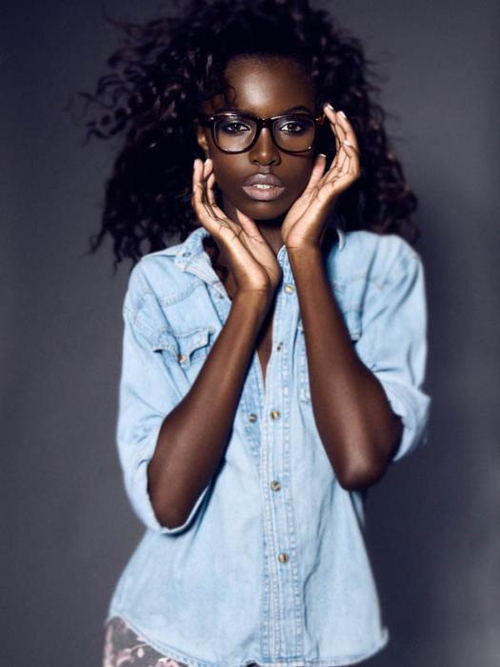
At 5ft 10.5in, with feline features and legs like a gazelle, Leomie Anderson makes quite an impression when she enters a room. With her hair tied back and wearing no makeup, the 18-year-old has the kind of beauty that is both knockout and approachable.
Anderson, who was spotted when she was 14 by a scout from Premier Model Management, is one of the stars of The Model Agency, Channel 4's new seven-part series following Premier's bookers, scouts and models, which starts tonight.
In her first season, last September, Anderson walked for Marc by Marc Jacobs, Giles, Topshop Unique, Ungaro and Loewe (for whom she opened the show). She also caught the eye of uber-stylist (and editor of biannual fashion magazine Love) Katie Grand. Inevitably, comparisons are being made with Naomi Campbell, whose career was also launched by Premier.
"I'm flattered people compare me to Naomi Campbell, because she's done so much in the modelling industry, but I don't want people to think I'm going to be 'the next Naomi'. I want to be my own person. I want to be known for my writing, not just modelling," says Anderson, who blogs for US magazine Essence.
Of course, there is room for more than one successful black model, but it does seem that popular culture can only deal with one at a time.
"It's a lot harder to start a black girl than a white girl, for a number of reasons," says Carole White, Premier's founder. "There's not so much work for them, and sometimes photographers and makeup artists are scared. They don't know how to light or make them up properly so it takes a lot longer . . . It's a slower process."
White first called for greater diversity in the fashion industry in 2008. "In the last couple of years there's been a movement of trying to get more black girls into the business, but it's an attitude. Right now everyone is scared – they think, if I take that risk, will she sell my products? So they go with the tried-and-tested white girls.
Is the fashion industry racist? "I don't think the industry is any more racist than anywhere else," says White. "It's driven by what sells and, in general, white blonde girls sell, that's the mindset. In actual fact, black girls do sell but they're not given as many openings. It is safer to go with a white girl, and in a recession people are very conservative."
Booker Annie Wilshaw puts it more strongly: "Yes, I'd say the industry is racist. In Milan black girls never work. In Paris it's still the same. It's 2011 and that's quite disgusting, really."
Wilshaw continues: "When the client sends you a brief you know straight away they're not talking about a black girl. They say they want 'a girl with long hair, who looks like a fairy' or something. When they want a black girl, they will say 'looking for mixed-race girl, tribal-prints location, desert scene'.
"It really bores me when photographers shoot black girls the same way, with a tribal print and some bright eye-shadow going on. Come on, that was Alek Wek in the 1990s, do something different."
Despite the success of some prominent black models, such as Puerto Rican Joan Smalls (who has just signed for L'Oréal), Chanel Iman and Jeneil Williams, Premier still warns its black girls that things will be harder for them.
"I explained to Leomie when we took her on that she won't get the options as easily as the white girls, because it's true, it's so much harder to develop the black girls. She has to work twice as hard to get picked up on," says Wilshaw.
Does Anderson think the industry is racist? "How can you expect fashion not to be slightly racist when the world is still racist? There's racism and prejudice in every aspect of life, so yes, fashion probably is a bit racist," she says.
Does she get disheartened? "There are a lot of girls, white, black, Chinese, Asian or whatever, who have got a lot stronger walk than me, or a unique look, and if a designer is looking for that particular look, and I haven't got it, maybe it's not because of my colour."
The backward idea that elite Fashion world is more ageist, ableist, heightist and weightist than RACIST is simply false! (by male model Tatenda Chimene)
London Fashion week: Black skin is the new Black
In a dog-eat-dog industry where black models struggle to find work, Philip Treacy's bold and mesmerising catwalk show featuring only black models is sensational progress


For a few brief hours toward the end of London’s glamorous Fashion week, Black literally was the new Black.
Fashion designer and milliner to the stars, Phillip Treacy lit up the cat walk with a cast of all Black models - 25 models including Leomie Anderson, Betty Adewole and Jourdan Dunn.
Not only was this a spectacular show with Treacy’s hats which instantly becomes works of art in their own right, but the imagery of exquisite craftsmanship and Nubian beauty has rocked the industry to its core.
This bold beautiful statement confronts the fashion world’s rigidity to what is beautiful.
Carole White, founder of Premier Model Management said,
I thought it was a really beautiful show and really welcome that he decided to use all Black models. It’s always difficult for Black girls to get work in shows… you can usually count them on one hand.
The fashion magazine Vogue attempted a similar feat by issuing all-Black models for its edition. It instantly became a best seller and one of the proudest moments in the magazine’s history. But as one insider Catherine Kallon puts it:
'these are great jaw dropping moments, but without consistency we are never going to see Black beauty as the norm.’
Kallon is right, of course. Until Black men and women are given the chance to become fashion writers, editors, designers and entrepreneurs, we are spoon fed a very limited diet of what is beauty.
'The black supermodels of the 1980s like Naomi Campbell and Iman have certainly made it a lot easier for the new generation but it is still harder to book black models.
'They will be used in spring/summer shows, when there is a tribal theme, but it is much harder in autumn/winter.'
The groundbreaking event, the Irish hat designer's first London show in ten years, was dedicated to Treacy's former muse Isabella Blow, who committed suicide in 2007, and Michael Jackson.
The absence of black models on fashion magazines covers and the runway is an issue which has provoked much debate over the years.
In 2008, Italian Vogue famously featured only black models in its July issue to highlight the subject.
The pictures were taken by New-York based photographer Steven Meisel.
'I thought, it's ridiculous, this discrimination. It's so crazy to live in such a narrow, narrow place. Age, weight, sexuality, race - every kind of prejudice,' he told the New York Times.
Meisel blamed designers, magazine editors and advertisers for the decline in the numbers of black women in fashion shows.
The magazine published a second all-black editorial in 2011.
On an encouraging note, I know for a fact that Supermodel Naomi Campbell has been exploring ways in which she can bring the power players of the industry together to bring about positive change.

Whilst Campbell and co quietly put together a plan to move the industry to a better place, let's saviour Treacy’s show as one of the highlights of London Fashion week.
Why did Dolce & Gabbana send racist earrings down the catwalk?
There's certainly nothing fashionable or cute about accessories that make light of colonial imagery.


Drawing inspiration from their native home of Sicily has been a long running theme for Dolce & Gabbana and their spring/summer collections have become known for vibrant, vintage-inspired prints and kitsch accessories. Last year they sent pasta and aubergine-shaped earrings down the runway, so it would only be fitting for them to match it with something equally as wacky this year. And what's wackier than a racist caricature of a black woman dangling from your earlobes? Aren't they adorable? Oh, and there's a dress to match too, so you can go for the full clueless colonial look if you want to.
The earrings are reminiscent of Blackamoor statues that can be found in Italy, but more recognisably to non-Italians, Aunt Jemima dolls. That's the same Aunt Jemima that, initially conceived as part of a minstrel show, became an image that romanticised slavery and plantation life. There's no denying they're offensive. But what's perhaps even more shocking is that no one highlighted this before the show. From the production to the fitting, was there really no one to point this out before they hit the catwalk?Some people might argue that they're harmless, even cute, but there's nothing cute about two white men selling minstrel earrings to a majority non-black audience. There wasn't a single black model in Dolce & Gabbana's show, and it's hard not to be appalled by the transparent exoticism in sending the only black faces down the runway in the form of earrings. Pandering to a long-gone era is hardly surprising in 2012, when people can't even take a photo of a baby without sticking a "vintage" sepia filter on top. Bygone eras and cultures are constantly drawn on by fashiondesigners to re-appropriate on a whim. But when you're explicitly pandering to such a shameful era of western racism and colonialism, it's time to move on to the future.
It is time for plain institutional racism within the fashion industry to stop! #StopRacismInFashion
Subscribe to:
Posts (Atom)